Flat Wash vs. Graded Wash vs Variegated Wash: What’s the Difference?
- LaLa

- Jul 18, 2025
- 3 min read

In watercolor painting, mastering washes is key to creating smooth, professional results. Some of the most foundational techniques—flat wash, graded wash and variegated wash—may look similar at first glance but serve very different purposes. In this post, we’ll break down each one, how to paint them, and when to use them in your artwork.
🎨 What is a Flat Wash?
A flat wash is a smooth, even layer of color with no variation from top to bottom. It’s perfect for painting skies, backgrounds, or any area where you want a consistent tone.
✅ How to Paint a Flat Wash:
Mix a generous amount of paint and water in your palette.
Use a large, soft brush (like a flat or mop brush).
Start at the top and work horizontally, overlapping each stroke slightly.
Keep the edge wet as you move downward to avoid streaks or lines.
Tilt your paper slightly to let gravity help.
🖼️ When to Use a Flat Wash:
Sky backgrounds
Wall colors in architectural pieces
Large areas of a single hue
Underpainting layers
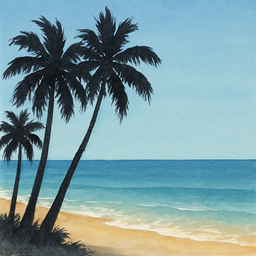
🎨 What is a Graded Wash?
A graded wash transitions gradually from dark to light (or color to clear) as you move down the paper. It’s ideal for adding dimension, light effects, or depth.
✅ How to Paint a Graded Wash:
Start with a strong pigment mix at the top.
As you paint downward, add more water to your brush and less pigment.
Allow each stroke to blend naturally into the one before.
Maintain a wet edge to avoid harsh lines.
🖼️ When to Use a Graded Wash:
Skies transitioning from dusk to light
Shadows with soft edges
Atmospheric perspective in landscapes
Stylized gradients or backgrounds

🌈What is a variegated wash?
A variegated wash in watercolor is a painting technique where two or more colors are blended together on the paper while still wet, creating a smooth, flowing transition between hues.
✅ How to Create a Variegated Wash:
Wet your paper (optional for softest blends).
Load your brush with one color and paint across part of the area.
Quickly switch to another color and overlap slightly into the first color while it’s still wet.
Let the pigments blend naturally.
Tilt the paper if needed to encourage smooth transitions.
🖼️ When to Use a Variegated Wash:
🌅 Skies and Sunsets
To show shifting colors in dawn or dusk skies (e.g. blue fading into pink or orange).
Creates natural, luminous gradients without flatness.
🌾 Landscapes and Fields
To suggest uneven light across hills, meadows, or distant terrain.
Mimics the variety in nature more realistically than a flat wash.
🍂 Leaves and Flowers
Useful for petals or leaves that change color due to light, shadow, or natural pigment variation (e.g. green fading into yellow or red).
🌊 Water and Reflections
To show movement and color shifts in oceans, lakes, or reflections.
Can suggest depth and subtle transitions in wet surfaces.
🎭 Atmospheric Effects
Mists, fog, or shifting light can be enhanced using gentle color changes.
Aids in creating soft, dreamy backgrounds.
🎨 Abstract or Expressive Work
Adds complexity and visual texture in expressive compositions.
Allows for spontaneous blends and “happy accidents.”

🆚 Flat Wash vs. Graded Wash – Quick Comparison
Feature | Flat Wash | Graded Wash |
Color Consistency | Even | Gradual change |
Difficulty | Easier for beginners | Requires brush control |
Use Case | Backgrounds, walls | Skies, shadows, transitions |
Technique | Same paint mix | Add water gradually |
🖌 Final Thoughts
Whether you're painting a calm blue sky or the subtle fade of a distant mountain, understanding how to use flat and graded washes will bring polish and professionalism to your watercolor work. Start with flat washes to build confidence, then experiment with graded washes to add drama and softness.


