🎉Fun Ways to Swatch Your Paint (That Don’t Feel Like Homework)

Swatching has a reputation for being boring little boxes. Neat grids. Labels everywhere.
Useful? Sure. Inspiring? Not always.
If you actually want to learn your paints—and enjoy the process—sometimes it helps to swatch in ways that feel more like painting and less like cataloging.
Here are some fun, low-pressure ways to swatch your paints that still teach you a lot.

◯ ◻︎ △ Paint Overlapping Figures
Instead of isolated shapes, paint simple overlapping forms:
circles
silhouettes
loose figures
abstract blobs
Where they overlap, you immediately see:
transparency vs opacity
how colors interact when layered
which pigments muddy and which stay clean
It’s a swatch and a composition experiment.

🌫️ Atmosphere Swatches
Try swatching the same color in:
a soft foggy wash
a darker atmospheric layer
a lifted highlight
a dry-brush edge
One color, four moods.
This is especially helpful for atmospheric painters because it shows how far a pigment can stretch emotionally—not just chromatically.
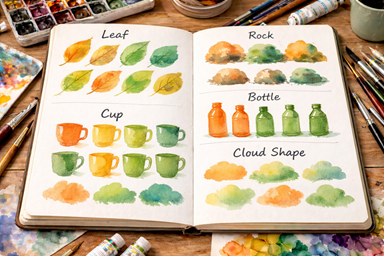
🍂 Paint the Same Simple Object Over and Over
Pick something uncomplicated:
a leaf
a rock
a bottle
a cup
a cloud shape
Paint it repeatedly using different colors.
You’ll learn:
which colors feel calm vs dramatic
which ones overpower a composition
which pigments quietly do the most work
This is swatching disguised as observation.
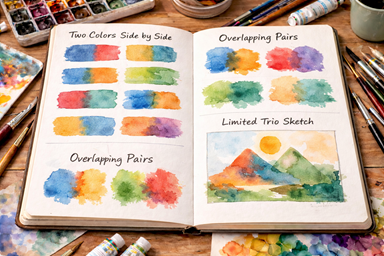
✧✧✧ Swatch in Pairs or Trios
Instead of single colors, swatch relationships:
two colors side by side
overlapping pairs
a limited trio used in one small sketch
You start to see:
temperature shifts
harmony vs tension
unexpected favorites
Bonus: these often turn into accidental mini paintings.
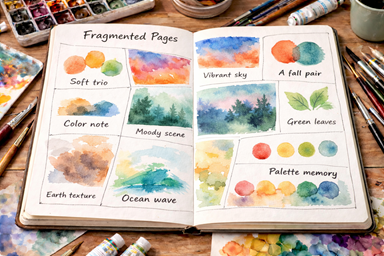
✂️ Fragmented Pages
Divide a page into irregular sections—no ruler, no grid.
Each section becomes:
a tiny test
a mood note
a color memory
This keeps swatching loose and prevents the “I must finish the whole page perfectly” feeling.
🖌️ Technique-Based Swatches
Instead of focusing on color alone, focus on how you apply it:
wet-in-wet
dry brush
lifting
glazing
splatter
edge control
The same pigment can look wildly different depending on technique—and that’s often more important than the color name.
🧠 Paint First, Label Later (or Not at All)
Sometimes the fastest way to kill curiosity is to label everything immediately.
Try painting first:
respond to the color
notice how it behaves
let it surprise you
You can always label later. Or keep some swatches unlabeled on purpose—just visual memory.
🎨 Why Playful Swatching Works Better
When swatching feels like play:
you’re more observant
you take more risks
you remember what you learned
You stop asking “What is this color supposed to do?” and start asking “What does it actually do in my hands?”
That’s where real familiarity comes from.
✨ The Takeaway
Swatching doesn’t have to be neat, finished, or impressive.
It just has to be honest.
If it teaches you how a color behaves, how it layers, how it feels in a painting—it’s doing its job.
Everything else is optional.